
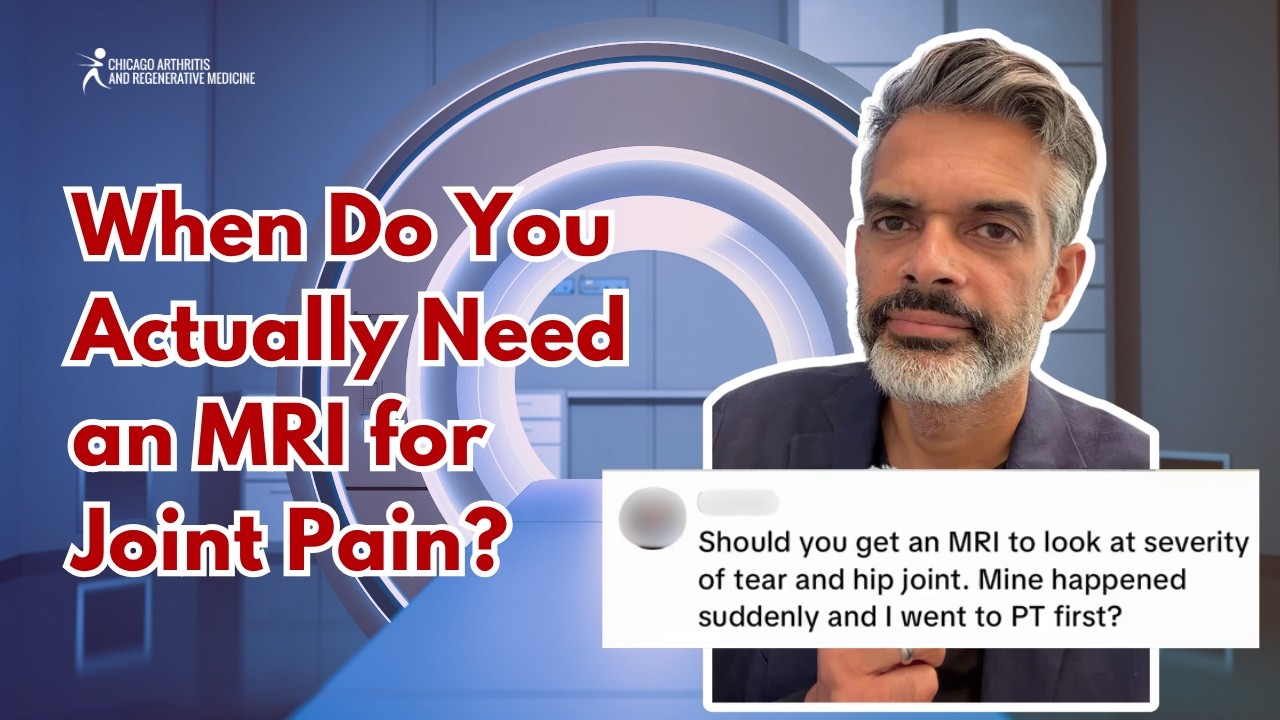
Do You Really Need an MRI for Your Joint Pain? A Chicago Rheumatologist Explains
If you’re dealing with joint pain, it’s natural to assume the next step is an MRI or CT scan. More imaging must mean a better diagnosis, right?
Not necessarily.
As a Chicago Rheumatologist specializing in regenerative medicine, one of the most common misconceptions I see is that advanced imaging is automatically the right next step for every painful joint. In reality, imaging is a tool — and like any tool, it’s only useful when it’s used at the right time, for the right reason.
Here’s how we actually decide when advanced imaging makes sense.
Why More Imaging Isn’t Always Better
MRI and CT scans can be incredibly valuable. But they’re most helpful when they answer a specific question — and when the answer will actually change your treatment plan.
Ordering imaging just because pain exists, without a clear purpose, can lead to confusing or even misleading results.
The Two Key Questions Before Ordering Imaging
When evaluating joint pain, we ask two things before recommending an MRI or CT scan:
- How certain are we about the diagnosis based on your history and physical exam?
- Will the result actually change what we do next?
Let’s break down why both matter.
Question 1: How Certain Is the Diagnosis Already?
Sometimes a diagnosis is clear just from a thorough history and physical exam — no imaging needed.
Other times, the exam points to a structural issue, and an MRI can help define exactly what’s happening.
The Catch: Imaging Finds a Lot of “Normal Abnormalities”
Here’s the tricky part. MRIs are very good at finding things — sometimes too good.
Common findings on imaging include:
- Labral tears
- Cartilage wear
- Disc changes
- Tendon abnormalities
The problem? Many of these show up in people who have little or no pain at all.
So finding something on an MRI doesn’t automatically mean that’s what’s causing your symptoms. The real goal is figuring out whether the abnormality is actually the source of your pain — not just confirming that an abnormality exists.
Imaging Isn’t Perfect, Either
Ironically, advanced imaging also isn’t 100% reliable at catching every problem.
A good example is chronic SI joint (sacroiliac joint) issues:
- SI joint instability often doesn’t show up well — or at all — on imaging
- SI joint inflammation can appear on MRI or CT, but again, not with 100% accuracy
In other words, a “clean” scan doesn’t always mean there isn’t a real problem.
Question 2: Will Imaging Actually Change Your Treatment?
This is arguably the most important question of all.
If your treatment is going to be physical therapy regardless of what the scan shows, jumping straight to an MRI may not add much value.
But if the findings could determine whether we consider:
- A joint injection
- A regenerative medicine treatment (like PRP therapy)
- Surgery
- Another targeted intervention
…then advanced imaging becomes genuinely useful, because it directly shapes your next steps.
A Real-World Example: Hip Pain
Let’s look at how this plays out with hip pain, one of the most common complaints we see.
Scenario A: Mild Hip Pain, Normal Exam
If someone has hip pain but relatively normal range of motion, no major mechanical symptoms, and nothing concerning on exam, it usually makes sense to:
- Start with physical therapy and conservative treatment
- At most, get a basic X-ray
- Hold off on MRI initially
If symptoms persist despite conservative treatment, that’s when advanced imaging adds real diagnostic value.
Scenario B: Hip Pain with Mechanical Symptoms
Now compare that to someone with:
- Restricted motion
- Catching or locking sensations
- Clear signs of hip impingement on exam
In this case, we’re much more interested in getting an MRI right away — because we need to know whether there’s a labral tear, cartilage damage, or another structural issue that could directly change the treatment plan.
The Bottom Line on Advanced Imaging
Advanced imaging is a powerful tool — but it’s not automatically the next step for every painful joint.
The best time to order an MRI or CT scan is when:
- There’s genuine diagnostic uncertainty, and
- The result is likely to change what we do next
This thoughtful, individualized approach is central to how we practice rheumatology and regenerative medicine — focusing on what actually helps you get better, not just gathering more pictures.
Struggling with Joint Pain or Arthritis in Chicago?
If you’re dealing with ongoing joint pain, arthritis, or an autoimmune condition, you don’t have to guess whether you need advanced imaging — or navigate treatment decisions alone.
Our Chicago rheumatology and regenerative medicine team can help you find the right diagnostic and treatment path, from conservative care to PRP therapy and beyond.
Visit ChicagoArthritis.com to learn more or schedule a consultation today.
Are Steroid Injections Making Knee Arthritis Worse?
Beyond Knees: Regenerative Medicine for Joints You Didn’t Know We Treat
Ice vs Heat for Knee Pain: What Works Best and What to Avoid After Regenerative Treatments