
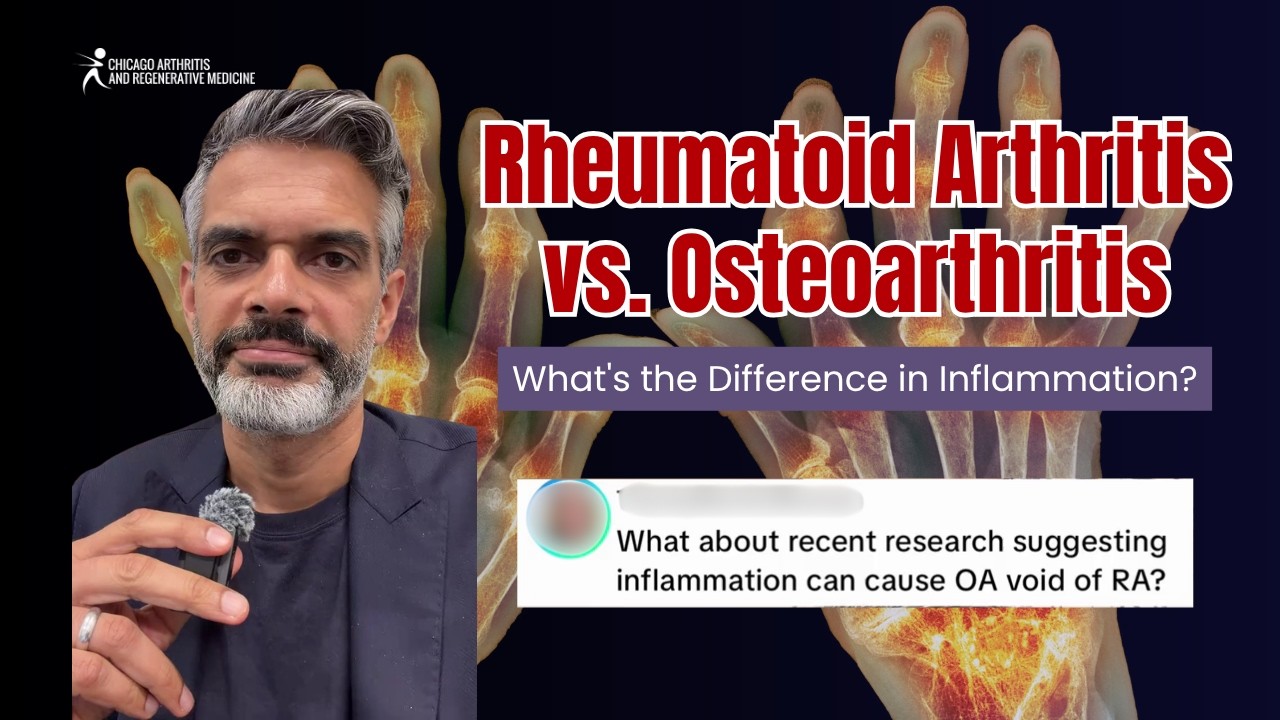
Rheumatoid Arthritis vs. Osteoarthritis: Is All Joint Inflammation the Same?
If you’re dealing with joint pain, swelling, or stiffness, you’ve probably heard both rheumatoid arthritis (RA) and osteoarthritis (OA) described as “inflammatory” conditions. But does that mean they’re treated the same way? Not even close.
Understanding the type of inflammation driving your joint pain is one of the most important steps toward getting the right treatment — and real relief. As a Chicago Rheumatologist specializing in both traditional rheumatology and regenerative medicine, Dr. Siddharth Tambar at Chicago Arthritis breaks down exactly how these two conditions differ, and why that difference matters for your care plan.
Rheumatoid Arthritis and Osteoarthritis: Similar Symptoms, Different Causes
Both RA and OA can cause:
- Joint pain
- Swelling
- Stiffness
- Loss of function
Because the symptoms overlap, many patients assume the underlying problem is the same. In reality, these two forms of arthritis come from completely different processes in the body — which is why a one-size-fits-all treatment approach doesn’t work.
What Is Rheumatoid Arthritis Inflammation?
Rheumatoid arthritis is a systemic autoimmune disease. This means the immune system becomes dysregulated and mistakenly attacks the lining of the joints, producing inflammatory cytokines that can damage cartilage and bone over time.
Because RA inflammation is systemic — meaning it affects the whole body, not just one joint — it can involve multiple joints at once and, in some cases, other organs as well.
Common Signs of RA
- Prolonged morning stiffness
- Visible swelling and warmth in the joints
- Pain in several joints at once, often symmetric
- Frequent involvement of the hands and wrists
- Pain that is worse in the morning and improves with activity
RA-related inflammation is typically severe — often geometrically higher in intensity than what’s seen in an osteoarthritic joint.
What Is Osteoarthritis Inflammation?
Osteoarthritis has traditionally been labeled as simple “wear-and-tear,” but that description is incomplete. OA is primarily a degenerative and biomechanical condition, driven by:
- Cartilage breakdown
- Abnormal joint loading
- Joint instability
- Prior injury
- Changes in the bone beneath the cartilage (subchondral bone)
As the joint becomes mechanically damaged, it can produce its own local inflammatory response and synovitis (inflammation of the joint lining). So yes — osteoarthritis can absolutely involve inflammation. It’s just usually a mild, localized inflammation happening inside a mechanically unhealthy joint, rather than a systemic autoimmune process affecting the entire body.
Common Signs of OA
- Pain that improves with rest
- Pain that worsens with activity
- Stiffness that is usually shorter-lived than RA
- Symptoms often concentrated in one or a few joints, especially weight-bearing ones
The Real Question: What’s Driving the Inflammation?
Instead of simply asking “is there inflammation?”, the better question is:
What is driving the inflammation — systemic autoimmunity, or a locally damaged and unstable joint?
Identifying the true driver is the key to choosing the right treatment path.
How Treatment Differs Between RA and OA
Treating Rheumatoid Arthritis
Because RA is driven by systemic autoimmune activity, the priority is controlling that inflammation with disease-modifying medications. Lifestyle factors like exercise, nutrition, sleep, and metabolic health are important supportive tools, but they do not replace appropriate medical treatment for RA.
Treating Osteoarthritis
Since OA is largely driven by mechanical factors, treatment focuses on addressing:
- Muscle weakness
- Joint instability
- Excess joint loading
- Poor movement patterns
…while also managing the local inflammation that develops. A comprehensive arthritis treatment plan for OA may include:
- Targeted exercise and physical therapy
- Weight optimization
- Anti-inflammatory treatments
- Injection-based or regenerative medicine options, such as:
- Prolotherapy
- PRP therapy (platelet-rich plasma)
- Bone marrow concentrate-derived stem cell therapy
Why This Distinction Matters for Your Care
Treating osteoarthritis like an autoimmune disease — or treating rheumatoid arthritis purely as a mechanical joint problem — can lead to delayed relief and, in the case of RA, potential joint damage if systemic inflammation isn’t properly controlled. Getting an accurate diagnosis from a rheumatology specialist ensures your treatment actually targets what’s driving your pain.
Find Lasting Joint Pain Relief in Chicago
Whether your joint pain is coming from autoimmune inflammation or a mechanically stressed joint, the team at Chicago Arthritis can help you identify the true cause and build a personalized treatment plan — from advanced autoimmune disease treatment to cutting-edge osteoarthritis treatment and regenerative options.
Ready to get answers about your joint pain? Visit ChicagoArthritis.com to learn more or schedule a consultation with our team today.
Shoulder Instability and Rotator Cuff Injuries
Best Non-Surgical Treatments for Shoulder Tendinitis
How to Tell if You Have a Shoulder Labral Tear and What to Do About It